
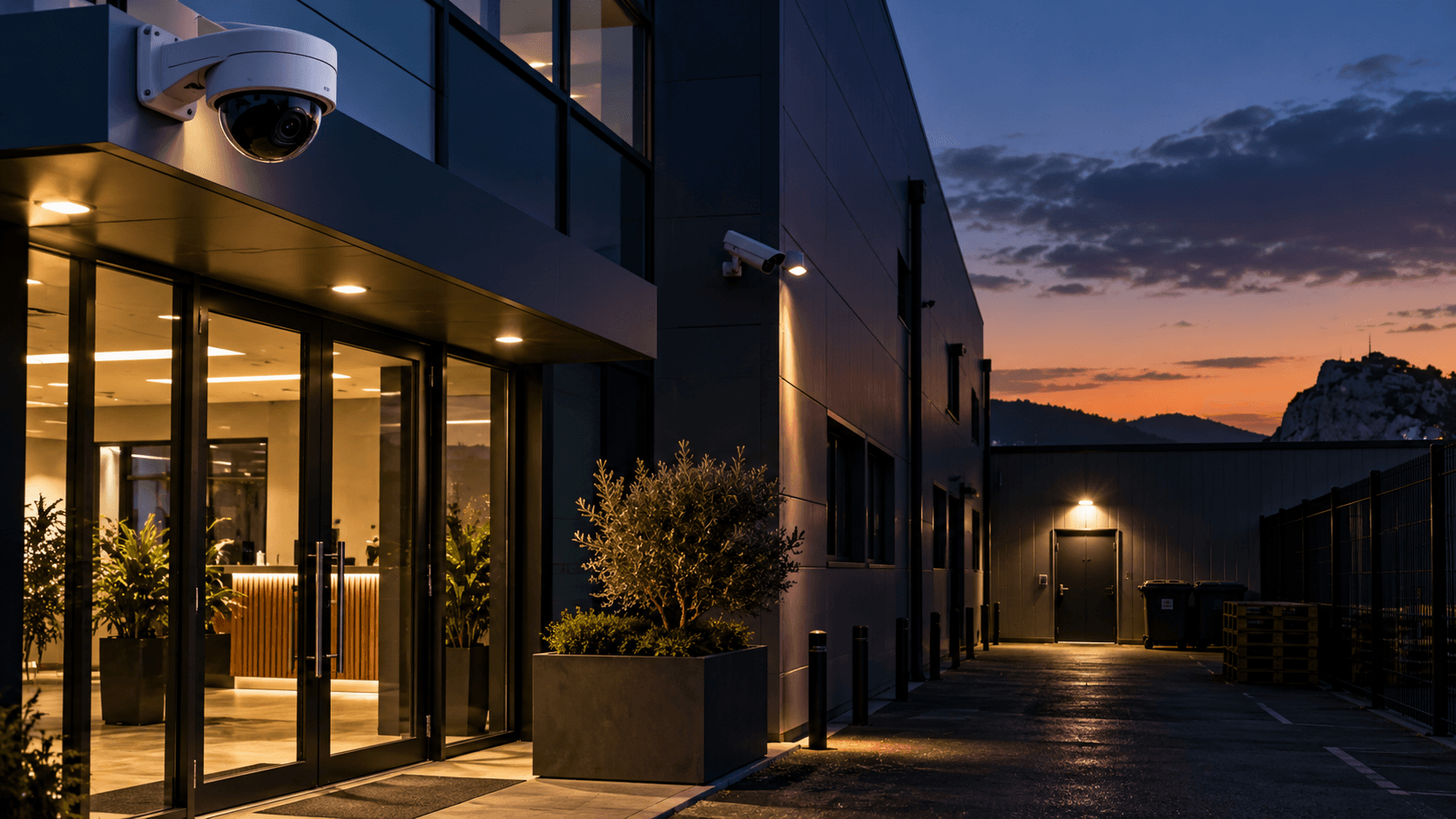
Most businesses have some form of security.
There might be CCTV above the entrance, an alarm that gets armed at closing time and good locks on the main doors. From the outside, everything appears protected.
But some of the biggest weaknesses we encounter aren't necessarily caused by businesses having no security. They're caused by the small areas nobody thought about.
A rear door outside the view of a camera. An alarm communicator dependent on the same internet connection as everything else. An old employee who still has access to the CCTV app. A recorder sitting somewhere obvious. Or a camera producing a fantastic picture during the day but very little useful detail at night.
These are security blind spots.
And they're worth thinking about.
The Rear of the Building
The front of a business usually receives plenty of attention. It's where customers enter, so naturally it's often where cameras, lighting and other security measures are concentrated. The rear can be very different. Service entrances, fire exits, delivery doors, alleyways and storage areas may receive considerably less attention despite sometimes being quieter and more concealed. Good security isn't necessarily about covering every inch of a building. It's about understanding where somebody can approach or enter without being noticed.
CCTV That Can See — But Can't Identify
A wide camera view can look impressive on a monitor. You can see the pavement, the road, several parked vehicles and everyone walking past. But there's an important difference between seeing that somebody was there and being able to identify useful detail about them. Camera position, height, viewing angle, resolution, lighting and distance all matter. This becomes particularly important around entrances, tills, loading areas and other locations where identification may be important. More coverage doesn't automatically mean better evidence.
What Happens After Dark
This is another common blind spot. A CCTV system is normally demonstrated and checked during working hours. Unfortunately, many incidents happen when businesses are closed. At night, lighting conditions completely change. Reflections can appear. Bright lights can overwhelm parts of the image. Dark areas can lose detail. Infrared illumination can reflect from nearby walls or surfaces. A security system should therefore be considered during the hours when the property is most vulnerable — not only when it's easiest to see.
The CCTV Recorder
People naturally notice the cameras. The recorder receives far less attention. Yet the NVR or DVR may contain all of the evidence captured by the CCTV system. Where that recorder is installed matters. Placing it somewhere obvious or easily accessible can create an unnecessary weakness. Depending on the business and its requirements, options such as securing the recorder, improving its location or adding compatible off-site/cloud recording can provide additional resilience.
The Internet Connection
Modern security systems are increasingly connected. CCTV apps, alarms, video intercoms and other devices may all use the business network or internet connection. That connectivity provides enormous convenience. But resilience matters too. A well-designed system should consider what continues operating when internet connectivity is unavailable. For example, many CCTV systems can continue recording locally even if remote viewing temporarily becomes unavailable. Alarm systems can also be designed with alternative communication methods where appropriate. The important thing is understanding what your system will actually do when something fails.
Former Employees and Old Phones
This is one of the least visible security weaknesses. Businesses change staff regularly. Over several years, different employees, managers, contractors and installers may have been given access to security systems. But access isn't always reviewed when somebody leaves. Physical keys are usually remembered because they're tangible. Digital access is easier to forget. CCTV accounts, alarm apps, access-control credentials and remote management accounts should therefore be treated just as seriously as physical keys.
The Door Everyone Uses
Security systems are often designed around official entrances. Real businesses don't always operate that way. Staff might regularly use a side entrance. Deliveries may arrive through another door. A rear door might remain open while stock is moved. Someone may prop a door open because they're going back outside in five minutes. Technology can only protect a business properly when it reflects how the business actually operates. Understanding everyday behaviour is therefore an important part of designing security.
The Network Cabinet
CCTV and security increasingly overlap with IT. IP cameras, NVRs, intercoms, access-control devices and other systems can all depend on network switches, PoE and connectivity. That makes the network infrastructure behind the security system important too. Poor cabling, overloaded PoE switches, incorrect network configuration or unreliable connectivity can turn perfectly good security equipment into an unreliable system. At Fortify, this is an area we pay particular attention to because security doesn't stop at the camera. The infrastructure behind it matters.
Fire Safety Can Have Blind Spots Too
The same thinking applies beyond security. Businesses evolve. Furniture moves. Rooms change purpose. Equipment gets added. Staff numbers increase. Storage areas change. Yet fire protection can remain exactly as it was years earlier. Fire extinguishers, fire detection, emergency lighting and escape arrangements should continue to reflect how a premises is actually being used. A system that was appropriate when installed shouldn't automatically be assumed to remain appropriate forever.
Small Details Can Make a Big Difference
Good security isn't necessarily about installing more equipment. Sometimes it's about finding the weaknesses between the equipment that's already there. A camera moved slightly. A blind spot beside a doorway. An old user account. A failing hard drive. An exposed recorder. A network problem. An area that looks completely different after dark. Individually, they can seem minor. Together, they can determine whether a security system actually performs when it's needed.
Looking at Security Differently
At Fortify Security Systems, we install new security systems across Gibraltar, but we also work with businesses that already have CCTV, alarms and other security equipment in place.
Sometimes existing systems simply need some attention. Sometimes they need upgrading. And sometimes they're perfectly good systems with one or two weaknesses that can be improved.
That's why we offer Security Health Checks, system takeovers, maintenance and ongoing support alongside new installations. Because good security isn't just about what's mounted on the wall. It's about making sure there aren't gaps between the things protecting you.